Author, Burning for Freedom

Author, Burning for Freedom
click image for my amazon page or to buy 'Burning for Freedom'

Wednesday, August 14, 2013

Give the Revolutionaries their due!


On this August 15, 2013, Independence Day of India I am posting an article written by Dr. Shreerang Godbole in 2008. I consider it a must-read.

“Another Independence Day, a seasonal outpouring of patriotism. The Prime Minister will deliver a lacklustre speech from the ramparts of Red Fort; loudspeakers will blare out patriotic Bollywood numbers; the Father of the Nation and the First Dynasty will be invoked.  We shall be told that the mighty British Empire was brought to its knees by a frail saint from Sabarmati without shedding a drop of blood, a feat unparalleled anywhere in the world.  There will be no mention of the blood that was shed, barring stray references to Bhagat Singh and Jallianwala Bagh. Any mention of the vivisection that preceded Independence is a strict no-no – we need to ‘maintain unity-integrity-peace-communal harmony.’
 
Bhagat Singh                 Rajguru                    Sukhdev
Post-Independence generations have been fed on a staple diet of false and motivated history - that we won freedom through non-violent means. A natural corollary of this theory is that British Rule was largely benign, despite some stray excesses. In return, the English gave us the railways, English education, a system of administration, a sense of oneness. A nation fed on the fiction of ‘freedom without bloody sacrifices’ can hardly cherish it, much less defend it with bloody sacrifices.

If truth be told, freedom was not won by pleas, prayers and petitions.  It was won IN SPITE OF Congressmen like Gandhi and Nehru who would have been happy with less. Gandhi was content as ‘the most obedient servant’ of the Empire (his own words), but that is a story still waiting to be told.


Freedom was won substantially by violent and armed struggle by revolutionaries, a process that culminated in the Naval Uprising of 1946. It was won thanks to the blood and tears of hundreds of nameless revolutionaries and their families who braved British barbarity and faced death, deportation, imprisonment and forfeiture of property.
Shyamji Krishnavarma

Lala Hardayal
Virendranath Chatopadhyay


The struggle was carried out not only in India, but also abroad, by people such as Shyamji Krishnavarma, Madam Bhikaji Cama, Barrister Sardarsingh Rana, Virendranath Chattopadhyaya, Sardar Ajit Singh, Lala Hardayal, Rasbehari Bose, Raja Mahendra Pratap and Champakraman Pillay. While Gandhi and Nehru enjoyed special status during their brief trips to jail, the worst atrocities were reserved for the revolutionaries.


Rash Behari Bose
Raja Mahendra Pratap Singh
Champakraman Pillay
Madame Cama

Sardar Ajit Singh
Barrister S. S. Rana


Consider Transportation – it effectively removed the revolutionaries from the theatre of war against the British without imparting them the halo of martyrdom. Through Transportation the British hoped to erase the memory of these freedom fighters from public consciousness.  In 1872, Ramsingh Kooka of Punjab was transported to Burma (Myanmar). Fifty of his followers were blown off guns without trial. 


Baba Ram Singh Kuka
In 1879, Vasudev Balwant Phadke of Pune was sentenced to Transportation for Life to Aden, 3200 km from Mumbai, by sea. Some 60-70 of his followers were sentenced to Transportation for Life and deported to the Andaman Islands. Even in exile, Phadke was denied the company of his followers. He died in Aden in 1883 clutching the soil of his motherland which he had kept with himself.


Vasudeo Balwant Phadke


In May 1907, Lala Lajpat Rai and Sardar Ajit Singh (uncle of Bhagat Singh) were transported from Lahore to Mandalay (Myanmar), 3400 km away. So strict was the security that the two leaders did not know that they were imprisoned in the same place. In 1908, at the age of 52 years, Lokmanya Tilak was sentenced to Transportation for 6 years to Mandalay and kept in isolation in an area of 150 ft x 50 ft with only the company of a cook. There was no parole for him even when his wife was on deathbed in 1912. The distance from Mumbai to Mandalay by sea and land is 4800 kms. The average life expectancy of an Indian male in 1908 was 48 years, so it is safe to presume the British wanted Tilak’s dead body to come out of prison.
Lokmanya Tilak


Lala Lajpat Rai


In 1909, Savarkar's elder brother Ganesh Damodar (Babarao) was sentenced to Transportation for life to the Andaman Islands, for publishing four poems. All his earthly possessions, including even saucepans and broom, were confiscated. His wife Yesu was left homeless, penniless and destitute. She sought refuge in the local crematorium for some time. She never saw her husband again and died in 1918. Permission to visit her husband came a day after she died!
Savarkar and Babarao
In the Andamans, Babarao was denied even basic medical treatment; it was a miracle that he survived. Even after his release, he was lodged in Belgaum (solitary confinement) and Sabarmati jails. He was finally released in September 1922 only when the British were convinced he was going to die. 

In 1911, Vinayak Damodar Savarkar was sentenced to Transportation for Life, twice, to Andaman Islands; the sentences were to be served in succession. Savarkar's personal property and possessions, including his spectacles, were confiscated. His father-in-law Mr Chiplunkar was Dewan of Jawhar principality in Thane district. British authorities forced the Raja of Jawhar to sack Chiplunkar and expel him from Jawhar state overnight. 

Transportation to Andaman Islands did not mean prison sentence for life. According to rules, regulations, customs and practice of the British Administration, prisoners were allowed to work outside the prison after a year or two, settle on the island, and call their families from India. Savarkar and his elder brother Babarao were detained in the prison for more than 10 years in flagrant violation of these rules! They were also forced to do physical hard labour all the time. 


In 1924, Savarkar was released from jail on condition that he would not leave Ratnagiri district and would abstain from political activities for five years. But the Raj extended this duration periodically so that Savarkar was unconditionally released only in 1937. Many contemporaries of Savarkar including Bhai Parmanand, Hotilal Varma and Hemchandra Das, were sentenced to Transportation for Life to the Andaman Islands.
Bhai Parmanand
Apart from the deaths at the gallows, many prisoners committed suicide to escape the harsh prison conditions. One of them was Indu Bhushan, an accused in the Alipore Bomb Case.  He was yoked to the oil-mill and tortured sadistically, which turned him into a physical and mental wreck. On 29 April 1912, he ended his agony by committing suicide.

Another accused in the Alipore Bomb Case, Ullaskar Dutta, was made to carry wet bricks and haul water up a hill. When he refused, he was yoked to the oil-mill and then made to stand handcuffed for a week. When he developed fever of 107 degrees F, he was made to stand in the blazing sun. When he became semi-conscious, his limp body was seized by jail officials and brutally thrashed. Only when a kindly doctor certified him insane was he let off. 
Ullaskar Dutt


Savarkar confessed he was also on the point of committing suicide on three occasions, but each time persuaded himself to fight the British to the last drop of his blood. He also prevented others from committing suicide.

The British did not spare the revolutionaries even after death. Madanlal Dhingra’s father was an eye specialist and Civil Surgeon at Amritsar. Some say he was the first Indian doctor to reach that eminent position. Madanlal was married and had a son. He had completed his studies and had he desired, he could have lived a life of luxury. But, he chose to be a martyr for India's freedom struggle and went to the gallows in August 1909.  Dhingra wished his last rites be performed according to Hindu Dharma and that he should be cremated. Many Hindus petitioned to Home Secretary Herbert Gladstone that Dhingra's body be handed over to them, as Brahmins were ready to perform the last rites. The request was denied! The body was put in a coffin and buried within the prison premises.

Madanlal Dhingra

Udham Singh
The vengeful attitude of the British did not diminish with time. Thirty-one years later they behaved just as barbarously. In March 1940, Udham Singh assassinated Michael O’ Dwyer, Governor of Punjab at the time of the Jallianwala Bagh massacre. The British refused cremation according to Hindu rites to Udham Singh also, and put his body in a coffin and buried it within the prison premises.

The sacrifices of these freedom fighters fuelled the fire of patriotism in the hearts of ordinary Indians during the freedom struggle. If our school children are taught about their sacrifices, they will become the Kshatriyas of tomorrow, ready to defend their dharma, sanskriti and rashtra from alien onslaughts.

Dr. Shreerang Godbole is a Pune-based endocrinologist, social activist and author. He has contributed in making www.savarkar.org 

Wednesday, August 7, 2013

The Very Special Vikram Edke


Hi, Everyone! Since researching and writing on Savarkar, I have had the good fortune to come across several people with whom I can connect. But there are two whom I consider very special. One is Dr. Shreerang Godbole, to whom I have dedicated my book Burning for Freedom, (I have posted on him in my category “Divine Interventions” and the other is Vikram Edke—to whom I shall dedicated the audio book of Burning for Freedom. Vikram is extremely dedicated to Savarkar and sees it as his honor and duty to do anything for Savarkar. That in itself is enough to make him special but there is also much, much more!

I first heard of Vikram almost a year ago. A friend of his bought B for F from me to send to him. I figured I might as well sign it and asked his name—but for this I may never have heard of him and that would have been a great loss! Along with his name I also learned that he gives lectures on Savarkar. I was so intrigued, I hotfooted it to Facebook to be“Friend” him.

At first I read his posts out of curiosity but shortly I was hooked. He really is an exceptional writer—a wonderful style, satire, humor, and very important for me: no swear words or bad-mouthing. But he writes only in Marathi and Hindi, and for me that was quite a stumbling block! My command over those languages is so-so at best and is completely dependent on my moods. If I feel off-color or disturbed, first thing to go out of the window is my understanding of Marathi and Hindi. So reading his posts was like running an obstacle race: race for bit; hit a snag; dash to the dictionary; then hop over the hurdle. But it was worth all the effort!

I discovered he has quite a repertoire of topics and puts them in today's context, too; besides Savarkar, he writes very knowledgably on other freedom fighters of India and writes and posts from other sources on ancient India. I really loved this. I am very fascinated in all ancient civilizations but somehow had never studied ancient India in any depth. The horizons of my knowledge widened noticeably, thanks to him.

I have an innate aversion to listening to anyone speak: speeches, talk shows, sermons et al. But Vikram is an excellent speaker and the only one I take time out to listen to. Not only does he have interesting information, he changes his approach to suit the audience. He writes the most wonderful poetry, too! Here is a link to one of his really special poems:
And a link to his other poems:  http://vikramedke.com/blog/category/poetry/

Soon another facet of his personality emerged: he was so very-well versed in Sanskrit, a scholar, in fact! He could quote and write authoritatively on Vedas and other valuable ancient Indian treasures. I particularly loved his “proofs of unimportance of caste in the Rigveda.” I was delighted when he wished me for my birthday in Sanskrit.

Since 2009, I look at the world from “how will this help Savarkar?” spectacles; so naturally right away it struck me that Vikram would be of great help to me in rescuing a couple of my Savarkar poem translations from limbo-land. Savarkar’s poems written in Sanskritized-Marathi are impossible for me to understand and yet of course, I have to translate them! I sent over a particularly difficult poem, Marnonmukh Shaiyyewar, to him and within minutes he replied giving meanings and explanations. That was a tremendous help for me in revising my translation and it has now seen the light of day.

Reader, in case you haven’t kept tally, I’ll put Vikram’s talents (at least those of which I am aware) in so many words: writer; poet; orator; scholar; historian, and lawyer. Not only does he have these talents, he is using them and very effectively, too! It seems to me his parents have named him very aptly: Vikram!

I always maintain that people reveal themselves when they speak and write (even if they don’t mean to) and I was impressed with the maturity of thought and the values that Vikram’s writing revealed. One day I discovered that he too, like me, is a deep believer in the Bhagavad Gita.

So you can see why he holds the “very special” spot in my life.

With all his talents and achievements, you might be forgiven in thinking that Vikram has reached an advanced age! Actually he is (if he’ll forgive me for saying it) very young. He turned 25 today.


I was listening to a radio show on which he was invited to speak, the lady asking him questions kept referring to him as “tu” rather than the respectful “tumhi” or “aapan”—a great solecism on her part! It is normal to accord respect to any learned personality; she shouldn’t have tossed it away just because he is young. I was sooooo mad! I hunted online for her contact information for two days to give her a piece of mind. Fortunately for her, I didn’t find it.

There is a lot more I could write, but I am going to save it for a second installment down the road. But this I shall certainly say, that Vikram’s and my path should cross is for me a case of “Divine Intervention.”

Anurupa

Sunday, July 7, 2013

Savarkar's Mindblowing marseilles Leap


“O Goddess of Freedom, Life is to die for you,
Death is to live without you!”
-         V. D. Savarkar, Jayostute (translation)

July 8, 1910 . . . that was the day Savarkar threw his heart over the fence and executed a most daring, magnificent escape at Marseilles harbor.

With that he thumbed his nose at the might of the British Raj and put it in a most sorry position! But there were many inherent dangers in his daring act and consequences of failure were dire.
What was going on in Savarkar’s mind before he took the leap?

Fortunately, that has been recorded by his biographer Chitragupta in Life of Barrister Savarkar.  During the British Raj days, Savarkar often wrote under a pseudonym. This biography is also purported to be written by Savarkar himself. Here are his thoughts, in the third person, before he leapt to freedom:

“Mr. Savarkar had weighed all the consequences of an attempt to escape in his mind. He knew that failure was almost certain under these most unfavorable and hostile circumstances. . . . And if failure was almost certain how terrible would be the consequences! He had read harrowing accounts of the cruelty that these very officers were capable of when in their calmer moods. To what demoniacal fury and tortures would they not subject him if thus they got exasperated by his attempt to break off from their custody? Then any such attempt was bound to lay him open to far more serious charges and was bound to prejudice his first case in a most damaging way. For as the case stood there could have been no substantial documentary or other reliable evidence strong enough to sustain all the charges against Mr. Savarkar, so cleverly had he worked throughout that otherwise reckless agitation. Even the best legal opinions, in spite of the confessions of his former comrades that were wrung out by the Police in India, were one on the point that if he chose to defend and if no further complications took place he could not get more than seven years or so in any ordinary conducted trial. But an attempt at such daring escape would doubtless furnish that much dreaded complication.

Yes: true it was that thus the price of failure would be most exacting. But if it succeeds? Succeeds even partially? What grand tradition of heroic fortitude would it not leave behind to raise the prestige of the Indian revolutionist party in the esteem of all mankind? It will take Europe by surprise. It will wash away the stigma that the leader of Abhinava Bharat was trapped by the Government as easily as one would trap a mouse.

No! His arrest must cost them much more than the arrest of any single private individual had ever done. It must tax the utmost ingenuity of the English Government and force them to stand mortified and humiliated before all Europe. If no help, well he would individually do it at any rate. It was worth risking worth doing. Failure or success, he will have the satisfaction of having played his own of Indian Independence. But if, in pursuit and hunt, they shoot? Well, it would be far more in keeping with his position as the president of the Abhinava Bharat, the leader of young Indian, to die in that fashion, to get shot in the struggle than to live to rot in the Andamanese dungeons or end his life on the gallows. He must risk. But the steamer was to sail just after day break. These guards are all closing and tightly pressing on both sides. Still, if at all, this is the time. Now or never!

He actually repeated to his mind “Now or never!”

Such were the thoughts running through the mind of this amazing man!
Watch my videos, Savarkar: the Great Escape, Part I & II on Youtube:
Savarkar: The Great Escape, Part I
Savarkar: The Great Escape, Part II


 Also watch two quick videos:
Savarkar’s Heroic Jump
The Savarkar Case Bungle up


1) Savarkar’s Heroic Jump:

     2) The Savarkar Case Bungle up:


The video, Point to Point Biography of Savarkar is a quick study guide to his biography. Click on the pictures with hands and on the swiveling targets to get more information (source documents, articles, videos, pictures etc.) in the PDF or PPT version. Those links are given in the description of the video.
Point to Point Biography of Savarkar

Anurupa

Friday, June 14, 2013

“The Joke of the Century”


“In words are seen the state of mind and character and disposition of the speaker.”

-         Plutarch


Hi, Everyone! Just yesterday—following my self-imposed task of rectifying misinformation re Savarkar that I come across anywhere—I found myself commenting back and forth with an FB Friend (me patiently pointing out his inaccurate, unjustified statement; he taking refuge in mockery) when he came up with a wisecrack that surely takes the cake!

Here I was thinking I have heard it all—the many unjust, untrue, maligning words re Savarkar—but no! There are always some more, it seems.

I had just made a statement to the effect that it was Savarkar’s amazing leadership, definitely not  "dictatorship," that enabled him to raise the Hindu Mahasabha into a strong political party capable of giving competition to the Congress in the elections.

To my consternation his reply was: “raising the Hindu Mahasabha into a strong, political party - Joke of the century - liked it!”

“Joke of the century”!!! Savarkar ground himself to dust to fight for a United India, for saving India from partition and here all his work was described as a "joke"! Impossible to put my emotions in words when I read those words.

I couldn’t help thinking again how unfortunate it is that so many Indians, far, far from appreciating their freedom fighters, cannot even muster up a modicum of respect for them.

However, despite the heavily promoted distortions in Indian history, Savarkar’s role in the politics of India, his role in raising Hindu Mahasabha from an embryo stage to a political force is a well-documented fact. Both, reputed historians and reputed biographers have recorded it in their books.

Any researcher of Savarkar (even the Savarkar-bashers) should be well aware of that. In the course of my research, I have dug up international corroboration of this fact. I have in my possession a boxful of newspapers clippings, reports, even an article that give testimony to Savarkar’s extraordinary political feat.

I am going to post some of them here. Keep in mind that Savarkar was released from twenty-seven years of British Bondage on May 10, 1937 and took over presidency of the Akhil Bharat Hindu Mahasabha only in December of 1937. He didn't have much time to turn things around!

1)    Clipping from The Lowell Sun (8/15/1942.) Note the first few words: “Hindu Mahasabha, India’s third largest political party . . .” and that in just four and half years!


  2) Clippings from The Billings Gazette (4/25/1939) and The Bakersfield California (4/24/1939)

By 1939 itself Savarkar was a force enough to send a cable to the President Roosevelt of United States! These clippings (and there are several more) give evidence of it. Savarkar’s cable reads: “If your note to Hitler was actuated by disinterested human anxiety for safeguarding freedom of democracy from military aggression, why not also ask Britain to withdraw armed domination over India, allowing a free self-determined constitution? The great Indian nation can claim as much international justice as small nations.”

3)    Mason City Globe-Gazette (1942)

This clipping says that Congress and Hindu Mahasabha will have to agree on any decision re future of India.

Syracuse Herald (3/22/42) This clipping clearly states that Hindu Mahasabha is one of the four “factions” whose opinions Sir Stafford Cripps will have to consider in deciding the future of India.


Definitely HM was a political force, wouldn’t you say?

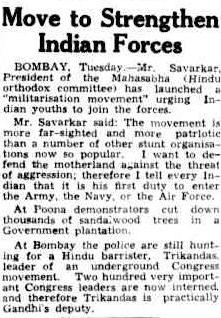
4)    Examiner (September 1942)
Here is a little clipping on Savarkar’s “Militarisation Movement.”

  5) Cullman Banna clipping (8/6/42)

Clearly mentions that this photo (the original was of very poor quality) is from the March of Time’s study “Crisis in India.” The write-up (incomplete here) gives some particulars of Savarkar.

6)    Excerpts from an interview of Savakar’s taken by an American journalist and published in the LA Times in 1943: “But he has a certain power of personality and is definitely a figure of some importance on the Indian political scene today . . . How he managed it I don't know, but despite all that confinement he was enough in tune with the spirit of the times to get into the political whirl and come to the top of a strong minority party which exerts a considerable influence today. He's a real story.”

7)    In 1945, J. M. Deb has written a book Blood and Tears featuring all the major parties of India and their role in Indian politics at the time. This book is important because it records history as it happened before distortions.
He too refers to HM as the third largest party in India. Here is a link to his piece on Savarkar and the Hindu Mahasabha:

All this gives a very good idea that Savarkar did indeed turn the Hindu Mahasabha into a political force. After reading this, if there is any truth in them, no one should find that statement the “joke of the century.”

However, if the Hindu Mahasabha was such a political force capable of giving the Congress a run for their money in the elections, why then did the Congress win the elections by a landslide?

What did happen?

That story of (Congress) dirty politics and treachery is well covered in my novel Burning for Freedom.


Anurupa